
Quick Summary Table
| Category | Key Information |
|---|---|
| Country | Malawi |
| Regional Context | Southern Africa – bordered by Tanzania, Zambia, Mozambique |
| Landscape Highlights | Nyika Plateau highlands, Shire River ecosystem, Lake Malawi islands |
| Flagship Parks | Nyika National Park, Liwonde National Park, Lake Malawi National Park |
| Wildlife Focus | Elephants, zebra, antelope species, buffalo, baboon, black rhino |
| Best Activity Mix | Walking trails, cycling routes, river safari, kayaking, snorkeling |
| Accommodation Mentioned | Chelinda Lodge (Nyika Plateau) |
| Access Nodes | Cape Maclear lakeshore town |
| Identity | Often described as the “Warm Heart of Africa” |
Opening Perspective – Why Malawi Deserves Structured Attention
Malawi is often described emotionally before it is described geographically. Small. Understated. Neighbor to larger names like Tanzania and Zambia. Yet scale can be strategic. When you examine Malawi not as a postcard but as a travel system, you notice something rare in African itineraries: compact ecological diversity that allows multiple experiences without logistical overload.
As one seasoned budget travel strategist once remarked, “Smaller countries often create better travel rhythm because transfer times shrink and immersion deepens.” Malawi fits that logic. You can move from highland plateau to river safari to freshwater island ecosystem within a single, coherent arc.
This guide shifts perspective. Not from wanderer to dreamer — but from traveler to planner.
Nyika Plateau – Highlands That Redefine Safari Expectations
Nyika Plateau
Nyika National Park
Chelinda Lodge
Established in 1965 and covering nearly 1,200 square miles, Nyika National Park is Malawi’s largest protected area. But unlike the flat savannah imagery many associate with Africa, Nyika unfolds as rolling highland grasslands punctuated by forests and valleys.
The altitude changes the experience.
Instead of relentless heat, you encounter open air. Instead of dust-heavy drives, you get flower-covered hills. Unlike more commercial safari corridors elsewhere in Africa, Nyika’s terrain encourages walking and cycling — not just vehicle-based wildlife viewing.
Zebra move across distant slopes. Antelope species graze in open grassland. The geography spreads wildlife rather than concentrating it artificially. That means sightings feel earned, not staged.
From a planning standpoint:
- Nyika works best as a slow segment.
- Allocate time for trails, not only drives.
- The landscape rewards daylight exploration.
Chelinda Lodge, tucked into the hillside, offers fireplace-equipped cottages. Rustic does not mean uncomfortable; it means atmosphere. Evenings here pivot around firelight conversations, a rhythm that contrasts sharply with high-traffic safari hubs elsewhere.
A travel essayist once observed, “The places that stay with you are rarely the loudest.” Nyika embodies that philosophy. Its impact is cumulative.
Liwonde National Park – The Shire River as Ecological Spine
Liwonde National Park
Shire River
African elephant
Black rhinoceros
Covering 211 square miles, Liwonde National Park is structured around water. The Shire River forms its western boundary and acts as the only outlet of Lake Malawi. In practical ecological terms, that makes the river the park’s circulatory system.
River safaris here shift the viewing angle entirely.
Instead of scanning distant plains, you glide parallel to the shoreline. Elephants approach to drink. Buffalo remain partially obscured in vegetation. Antelope gather near riverbanks. Birdlife intensifies.
Liwonde holds Malawi’s largest elephant population and also protects the rare black rhinoceros. Wildlife density is not accidental — it concentrates around water corridors.
Planning insights:
- Boat safaris provide proximity without disturbance.
- Vegetation along the river attracts kudu, sable antelope, and smaller mammals.
- Woodland zones host baboons and buffalo.
The shift from Nyika’s open plateau to Liwonde’s riverine density creates narrative contrast within a single itinerary. One location emphasizes altitude and space; the other emphasizes water and movement.
A practical planner sees opportunity: design your Malawi route so ecological textures change progressively.
Lake Malawi – Freshwater Ecosystem at Continental Scale
Lake Malawi
Lake Malawi National Park
Mumbo Island
Cape Maclear
African fish eagle
Lake Malawi alters expectations again. It is not coastal ocean. It is inland freshwater — one of the largest lakes in Africa.
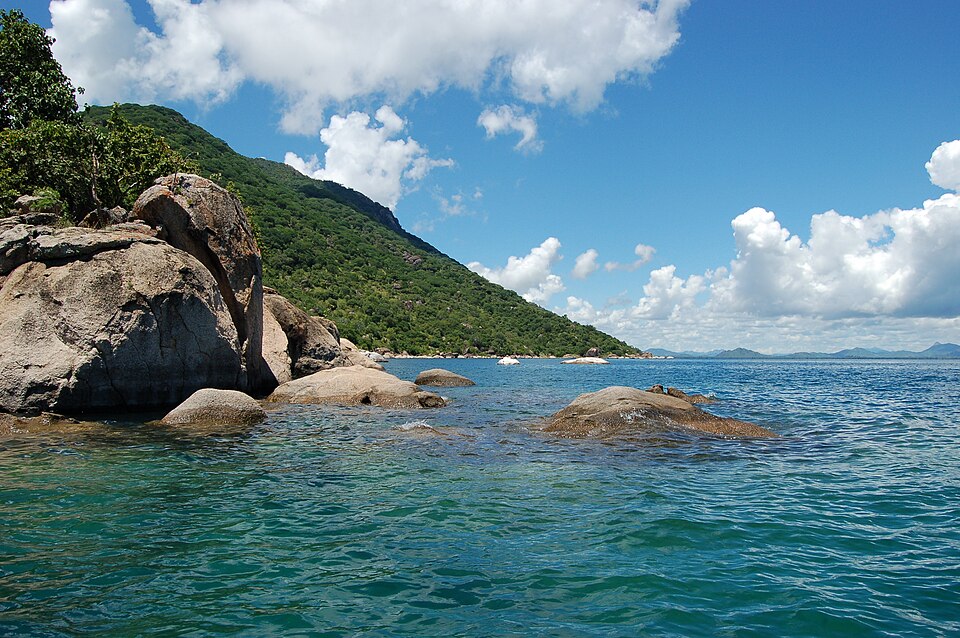
Scattered across its surface are remote islands, including Mumbo Island inside Lake Malawi National Park — the world’s first freshwater national park and a recognized UNESCO site. The area protects hundreds of tropical fish species found nowhere else.
From Cape Maclear, travelers kayak to island camps. This is active access, not passive transfer. Kayaking introduces scale: the lake feels expansive yet navigable.
Common activities:
- Snorkeling among vividly colored freshwater fish.
- Sunset observation from rocky shorelines.
- Listening for the distinct call of the African fish eagle overhead.
Unlike ocean islands, Lake Malawi’s water clarity makes underwater observation accessible without deep diving skills.
Planning dimension:
- Combine kayaking and island camping for immersion.
- Use Cape Maclear as a transition node.
- Schedule time around sunset cycles — lake light changes rapidly.
A reflective travel thinker once wrote, “Water alters the way we measure distance.” Lake Malawi compresses psychological distance between wildlife safari and aquatic retreat — a rare combination within one national border.
Community Dimension – Hospitality as Infrastructure
Malawi is widely known as the “Warm Heart of Africa.” But warmth is not branding — it is lived interaction. Visitors consistently note the open reception extended by local communities.
For planners, this matters.
Travel is not only landscape logistics. It is social navigation. In Malawi, visitor integration tends to feel less transactional and more conversational.
Community-driven tourism supports:
- Lakeshore villages near Cape Maclear.
- Lodge staff engagement in Nyika.
- River guide expertise in Liwonde.
When multiple independent sources — reviews, travel forums, field accounts — converge on one theme, planners take note. In Malawi’s case, hospitality repeatedly emerges as structural strength.
Things the Media Doesn’t Tell You
- Malawi’s scale is its advantage.
While larger neighbors dominate safari marketing, Malawi’s compact geography allows planners to design multi-ecosystem itineraries without extreme internal flights. - Wildlife density varies by zone.
Nyika is not Serengeti-style density. It offers dispersed encounters. Liwonde compensates with concentrated river sightings. Planning must reflect ecological differences. - Freshwater snorkeling changes expectations.
Many travelers associate snorkeling with coral reefs. Lake Malawi offers freshwater biodiversity — scientifically significant and visually striking. - Evenings define memory.
Fireplace gatherings at Chelinda. Riverside stillness at Liwonde. Island sunsets near Mumbo. Media often shows daylight wildlife; it rarely emphasizes twilight atmosphere. - Access requires sequencing.
Malawi is ideal when structured logically: Highlands → River Safari → Lake. Reversing randomly weakens experiential contrast. - Data gathering is essential before departure.
If you cannot visit first:- Read negative reviews for accommodation patterns.
- Scan Google Maps for recent photos.
- Watch updated vlogs of Cape Maclear transfers.
- Explore Facebook travel groups for seasonal insights.
Planners rely on layered information, not romantic summaries.
Multi-Dimensional Itinerary Framework
Segment 1: Nyika Plateau (Highland Ecology)
Focus: walking, cycling, landscape immersion.
Accommodation: Chelinda Lodge.
Segment 2: Liwonde National Park (Riverine Wildlife)
Focus: boat safaris along Shire River, elephant proximity, black rhino conservation zones.
Segment 3: Lake Malawi (Freshwater Island Ecosystem)
Focus: kayaking from Cape Maclear, snorkeling at Mumbo Island, sunset ecology observation.
This sequencing avoids repetition. Each segment feels structurally different.
Why Malawi Works
Malawi does not compete by scale. It competes by coherence.
Highland plateau. River corridor. Freshwater lake system.
Within one national framework, you transition across altitude, vegetation type, wildlife density, and aquatic biodiversity. For planners seeking diversity without fragmentation, Malawi offers rare structural efficiency.
And that is the real strength rarely highlighted in surface-level travel articles.
Malawi Without the Gloss – Real Wildlife Access Lake Routes Highland Stays.
Malawi travel guide, Nyika Plateau safari, Liwonde National Park, Lake Malawi islands, Mumbo Island kayak, Cape Maclear travel, Shire River safari, Malawi wildlife itinerary, African freshwater park, Chelinda Lodge stay, Malawi safari planning, black rhino Malawi, African fish eagle, Malawi highland trekking, Southern Africa travel route
